Bank of England Raises Bank Rate to 4% in First Hike in Over Three Years
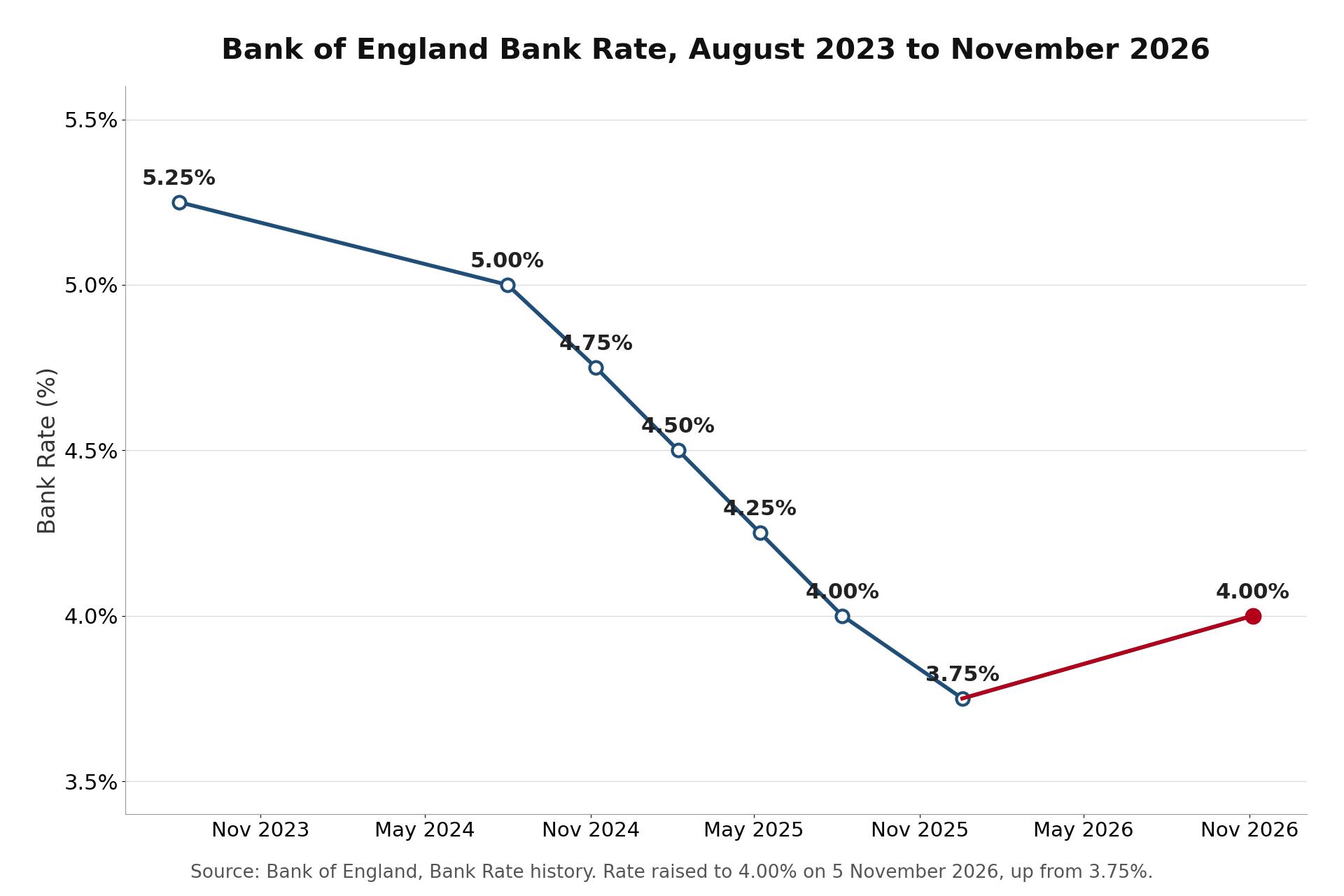
The Bank of England has raised interest rates for the first time in more than three years. On 5 November 2026, its Monetary Policy Committee voted 8 to 1 to increase Bank Rate by 0.25 percentage points, to 4%. It is the first increase since the rise to 5.25% on 3 August 2023.
UK CPI inflation rose to 3.5% in September 2026, and the Bank now projects it will reach around 5% by the middle of next year. That projection, not an observed result, is what pushed the Committee to act.
What the Bank decided
The Committee's meeting ended on 4 November 2026, and the decision was announced on 5 November. Eight members voted for the 0.25 percentage point rise: Andrew Bailey, Sarah Breeden, Swati Dhingra, Megan Greene, Clare Lombardelli, Huw Pill, Dave Ramsden and Alan Taylor. Catherine L Mann voted against, preferring a larger 0.5 percentage point increase to 4.25%.
Mann's stated reason was that an activist approach was needed to prevent persistent inflationary dynamics becoming embedded. In her own view, projected CPI inflation reaches 4.9% by mid-2027, and it would be some 25 basis points higher absent the measures announced at the latest Budget. That is her individual view, not the Committee's central projection.
Why inflation forced the move
The September figures, published on 21 October 2026, gave the Committee little room to wait. CPI rose by 3.5% in the 12 months to September 2026, up from 3.1% in August.
Core CPI, which excludes energy, food, alcohol and tobacco, rose by 2.8% in the 12 months to September, up from 2.6% in August. CPI services rose from 3.4% to 3.7%, and CPI goods rose from 2.7% to 3.2%.
Transport, particularly motor fuels, made the largest upward contribution to the monthly change in the annual rates. Motor fuel prices rose by 29.8% in the 12 months to September 2026. Average petrol was 169.5 pence per litre in September 2026, the highest since August 2022, and average diesel was 192.5 pence per litre, the highest since July 2022.
Energy prices and the ninth month of conflict
The driver is energy. The Monetary Policy Summary states: "The conflict in the Middle East is now in its ninth month. Global energy prices have continued to rise from an already elevated level."
Front-month Brent crude oil futures and UK front-month natural gas futures averaged 108 US dollars per barrel and 216 pence per therm over the 15 UK working days ending 27 October, 38% and 81% higher than at the time of the July Monetary Policy Report. Direct energy effects contributed around 1 percentage point to the September CPI outturn of 3.5%.
The Bank says there is limited evidence so far of knock-on effects on other prices and wages, but the pressure in the pipeline is now sufficient to warrant an increase. The risk of second-round effects has risen; they have not already happened.
The inflation outlook: around 5% by mid-2027
The Summary states: "UK CPI inflation increased to 3.5% in September. It is now expected to rise to around 5% by the middle of next year." Bank staff projected around 4.5% in 2027 Q1 and around 5% in 2027 Q2.
That 5% is a projection, not an observed outcome. The central projection then has inflation returning to the 2% target in 2028 Q3.
Will there be another rise?
Governor Andrew Bailey said: "Today's increase shouldn't be seen as the first in an inevitable long sequence of hikes. But, unless the conflict in the Middle East is resolved, neither does it seem likely to be the last increase."
Megan Greene said: "Additional hikes will likely be required going forward." Clare Lombardelli said: "In the absence of evidence of weaker inflation pressures, there is likely to be a case for a further increase in rates in the near term." Huw Pill said "a single 25-basis point hike is unlikely to be sufficient."
But the Summary states: "Monetary policy is not on a pre-set path. The Committee will continue to assess the evidence at each meeting." Alan Taylor said: "as of now, this is not the start of a hiking cycle: policy isn't on a pre-set, unconditional path... The next move could be up, down, or sideways." A further rise is likely unless the conflict is resolved, but the next move is not decided. The same week saw Australia's central bank move in the same direction (report on the RBA November 3 decision).
Markets, growth and mortgages
Surveyed market participants expect more tightening. The median of responses to the November 2026 Market Participants Survey expected Bank Rate to increase to 4% in November and to 4.25% in February. That is the median of survey respondents' expectations, not a Bank promise.
The growth picture is mixed. Table 3.B of the November Monetary Policy Report gives four-quarter growth in real GDP: 2.2% in 2026 Q4, up from 1.2% in the July Report, and 1.0% in 2027 Q4, down from 1.4% in the July Report. Growth for the end of 2026 was revised up, but growth for the end of 2027 was revised down. Unemployment is projected to rise slightly, reaching 5.1% in 2028 Q4.
Fixed-rate borrowers are protected for now. With a fixed-rate mortgage, the rate stays the same for the length of the deal, usually 2 to 10 years. MoneyHelper states: "You're not affected by rising interest rates during your fixed term." Tracker rates follow the Bank of England's base rate plus a few percent: "if the base rate goes up by 0.5%, your rate goes up by 0.5%."
Each lender sets its own standard variable rate, which can change at any time. A standard variable rate does not move automatically with Bank Rate; tracker mortgages are the ones that follow Bank Rate directly.
The pressure is already visible. Quoted rates on 75% and 90% loan-to-value mortgages have increased by around 60 basis points on average since the July Report. Mortgage approvals for house purchase fell by 8% in the three months to September, relative to the three months prior. The Bank projects that by the end of 2029, average annual mortgage payments will be around 700 pounds higher than at the time of the July Report and around 1,500 pounds higher than before the conflict in the Middle East.

Frequently Asked Questions
When did the Bank of England raise rates to 4%?
The decision was announced on 5 November 2026, after a meeting that ended on 4 November. The Committee voted 8 to 1 to raise Bank Rate by 0.25 percentage points, to 4%. It is the first increase since 3 August 2023.
Why did the Bank raise rates?
Inflation rose to 3.5% in September 2026, and the Bank projects it will reach around 5% by mid-2027. Energy is the main driver: the conflict in the Middle East is in its ninth month. The Bank says there is limited evidence so far of knock-on effects.
Is inflation really going to hit 5%?
That is the Bank's central projection, not an observed outcome. Bank staff projected headline CPI inflation to reach around 4.5% in 2027 Q1 and around 5% in 2027 Q2, before returning to the 2% target in 2028 Q3.
Will the Bank raise rates again?
Possibly, but nothing is decided. Governor Andrew Bailey said the increase is unlikely to be the last unless the conflict in the Middle East is resolved. But policy is not on a pre-set path, and Alan Taylor said the next move could be up, down, or sideways.
What does the rate rise mean for my mortgage?
It depends on your deal. Fixed-rate borrowers are unaffected during their fixed term. Tracker-rate borrowers will see their rate rise in line with Bank Rate. Standard variable rates are set by each lender and can change at any time, but they do not move automatically with Bank Rate. The Bank projects average annual mortgage payments will be around 700 pounds higher by the end of 2029 than at the time of the July Report.
What are markets expecting?
The median of responses to the November 2026 Market Participants Survey expected Bank Rate to rise to 4% in November and to 4.25% in February. That is the median of survey respondents' expectations, not a Bank promise.
Sources: Bank of England (Monetary Policy Summary and Minutes; Monetary Policy Report, November 2026; interest rate page; Bank Rate history); ONS, Consumer price inflation, UK: September 2026; MoneyHelper, Understanding mortgages and interest rates. All figures checked against the issuing organisations' own pages on 6 November 2026.