Entryway Organization Ideas for Small Homes
You walk in the door and your shoes land on the pile by the mat. Your keys slide somewhere near the mail you swore you'd sort. Your coat gets draped over a chair because the hooks — if you have any — are already full. If your home doesn't have a real entryway, you are not alone.
Here's what you'll learn in this guide to entryway organization ideas for small spaces: how to create a working entry zone in a few square feet (or none at all), shoe storage that keeps the pile from growing, renter-friendly hooks and racks for coats and bags, a landing spot for keys, wallets, and mail, a plan for rotating seasonal gear, and cheap ways to make the whole setup look welcoming. No mudroom, no closet, no problem.
Entryway Organization Ideas That Create a Zone Where There Isn't One
In many apartments and smaller homes, the front door opens straight into the living room or kitchen. That doesn't mean you can't have an entryway — it just means you define it yourself.
Anchor it with a rug. A small washable rug, even two or three feet wide, marks the boundary between "outside" and "inside." It tells shoes where to stop and gives guests a visual cue to pause. Washable rugs are the move here, since this spot takes a beating.
Use furniture to fake a wall. A low bookshelf, narrow console, or freestanding clothing rack placed perpendicular to the wall creates a mini-foyer. Leave enough room to walk through.
Light it. Small entryways often have no overhead light. A plug-in sconce, a battery-operated puck light, or a small lamp on the console makes the area feel intentional instead of forgotten.
Tame the Shoe Mountain
The shoe pile is the number one symptom of a disorganized entryway, and it usually isn't a storage problem — it's a limit problem.
Set a household shoe cap. Two pairs per person by the door: the ones you're wearing today and one backup. Everything else lives in the closet or bedroom. This single rule does more than any storage product ever will.
Choose storage that fits your footprint:
- Wall-mounted flip cabinets: These sit less than a foot from the wall, and each tilt-down compartment holds a few pairs — a whole shoe pile in the footprint of a radiator.
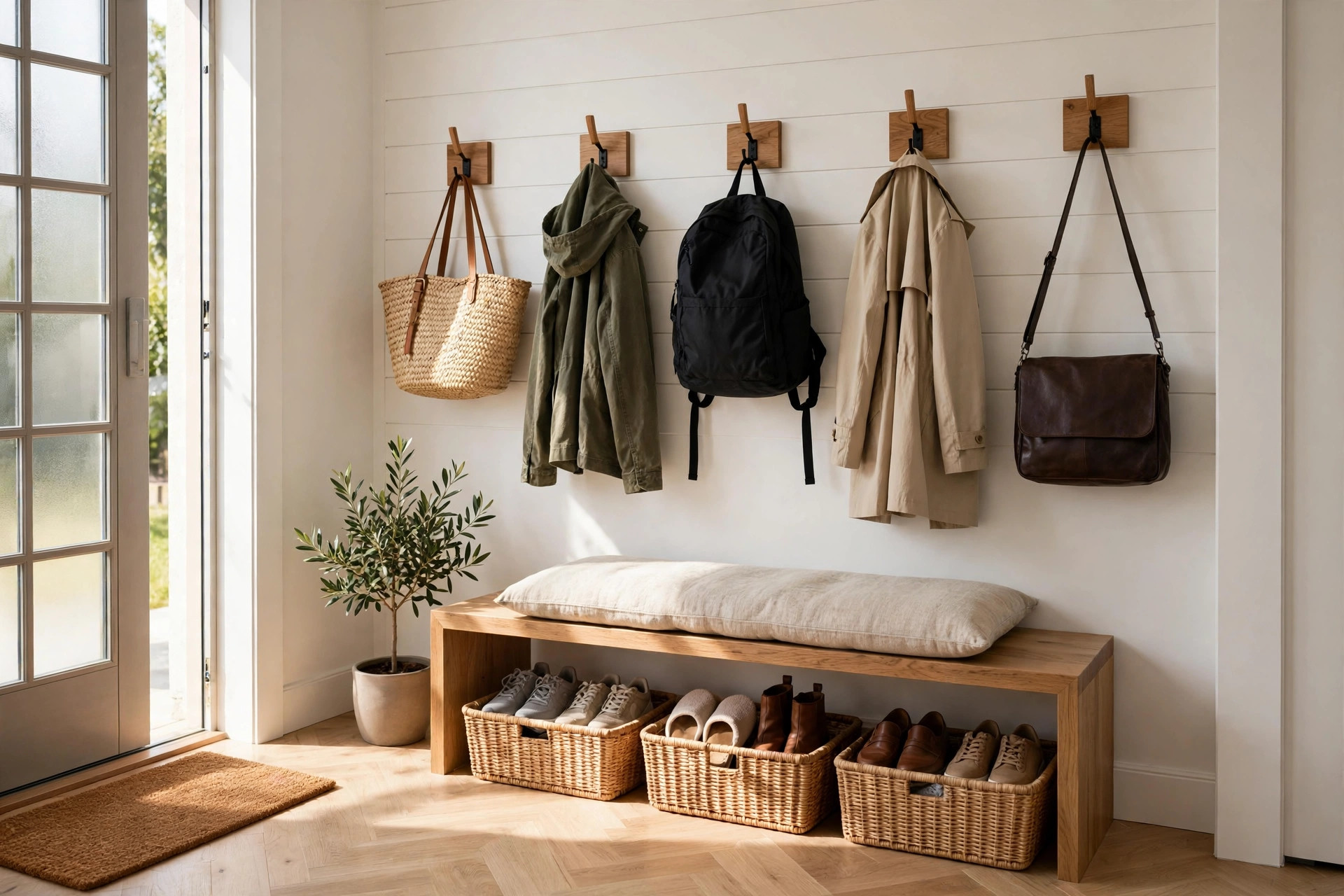
- Under-bench or under-console baskets: One basket per person keeps pairs corralled where you actually take them off.
- A boot tray for wet weather: One wipeable tray catches winter slush and summer rain so wet shoes never migrate onto the rug.
Skip the giant shoe tower. Tall organizers hold dozens of pairs, which sounds great until every shoe you own lives next to the front door. In a small home, that's just relocating the clutter vertically.
Coats, Bags, and Jackets Without a Coat Closet
A coat closet is a luxury. Here's the renter-friendly toolkit for hanging everything without drilling holes.
Adhesive hooks, used properly. Modern adhesive hooks hold real weight — but only if you install them right. Clean the wall with rubbing alcohol first, press firmly for 30 seconds, and wait the full curing time (usually 24 hours) before hanging anything. One hook per person at a reachable height, plus one or two for guests.
Tension-mounted or leaning coat racks. A freestanding rack in a corner costs little, needs no screws, and moves with you when your lease ends. It has to be within arm's reach of the door, or nobody will use it.
Slim wall-mounted hook rails. If your landlord allows small screw holes (spackle fills them), a short rail with three to five hooks plus a top shelf is the highest-value upgrade you can make.
The one-in-one-out rule. When the hooks are full, something goes back in the closet before anything new goes up. This keeps the rack at working capacity instead of turning it into a second closet.
Build a Landing Zone for Keys, Wallets, and Mail
Small items cause the biggest headaches because they disappear. The fix is a landing zone: one dedicated surface where pocket contents live the second you walk in.
The tray method. A small tray or shallow bowl on your console, shelf, or wall-mounted ledge is the entire system. Keys go in, wallet goes in, done.
Mount it to save surface space. A magnetic strip or a small floating shelf near the door at hand height keeps keys off the counter. Anything that stops the "drop it on the nearest flat surface" habit works.
Tame the mail immediately. Keep a small sorter or two labeled folders on the landing shelf: action needed and recycle. Toss the junk on the spot; bills and replies go in the action folder, which you check once or twice a week. Mail piles up because it has nowhere to go, not because there's too much of it.
Leave a bowl for the odd bits. Sunglasses, loose change, a bus card, the dog's treat pouch — a catch-all dish with a defined spot beats the same items scattered across three rooms.
Rotate Seasonal Gear (Don't Store All of It by the Door)
The entryway feels cramped because it's holding four seasons of stuff at once. Keep only the current season out: heavy coats, boots, hats, and gloves in winter; one light jacket, rain gear, and sunglasses in summer. Everything else goes into a labeled bin in a closet, under the bed, or on a high shelf.
Do a seasonal swap twice a year. Fifteen minutes, one labeled bin: pull out-of-season items from the entryway, wipe down the hooks and shelves, and move the next season's gear in. Store the off-season bin on a high shelf, in a closet, or under the bed.
Keep one "just in case" tote. A single tote or basket with the crossover items — an umbrella, a reusable shopping bag, a light scarf — so you don't end up storing three umbrellas and five tote bags by the door.
Make a Tiny Foyer Feel Welcoming on a Budget
Function first, but a few dollars of intention go a long way — an entryway that looks cared for gets kept tidy.
A mirror does double duty. A small mirror near the door lets you check yourself on the way out and makes a tight space feel bigger and brighter. Lean a floor mirror against the wall or hang a small one with an adhesive strip.
One piece of personality. A framed print, a thrifted piece of art, or a small plant signals "home" instead of "storage area." One item is plenty.
Keep scents simple. Entries pick up shoe and coat smells fast. A washable rug you actually wash, plus a small open container of baking soda tucked behind the shoe storage, beats any spray.
Total budget reality check: a washable runner, a set of adhesive hooks, a tray, and a thrifted mirror can cost less than one piece of entryway furniture. Start with the rug and the tray — the two things that change behavior fastest.
Keep It Working: The Five-Minute Entry Reset
Even the best setup drifts. The maintenance plan is tiny:
- Nightly: shoes back in their spot, keys in the tray, one quick look at the mail sorter.
- Weekly: toss the junk mail, check that hooks aren't overloaded.
- Seasonally: the fifteen-minute gear swap described above.
A small entryway doesn't need a big system — it needs a small one you actually follow.
Frequently Asked Questions
How do I organize an entryway with no closet and no foyer? Define the zone yourself: a washable rug to mark the space, a slim bench or console against the nearest wall, reachable adhesive hooks, and a key tray by the door.
What is the best shoe storage for a very small entryway? A per-person cap (two pairs each) plus slim storage: a wall-mounted flip-front shoe cabinet or one basket per person under a bench. Skip tall towers that invite your whole collection by the door, and keep a boot tray for wet weather.
Are adhesive hooks strong enough for coats and bags? Yes, if installed correctly — clean the surface with rubbing alcohol, press firmly, and let them cure for 24 hours before use. Choose large hooks rated for several pounds each, and give each heavy item its own hook.
How do I stop mail from piling up by the door? Give mail two labeled destinations at the landing zone: an action folder and a recycle spot. Sort the moment you walk in — most of what arrives is junk, and tossing it immediately is the whole trick.
How can I make a small entryway look nice on a budget? A washable rug, a thrifted mirror, one piece of art or a plant, and lidded baskets to hide clutter. Small touches make the space feel finished, and finished spaces stay tidier.