Mortgage Rates Weekly vs Daily: 7.28% vs 7.33% in November

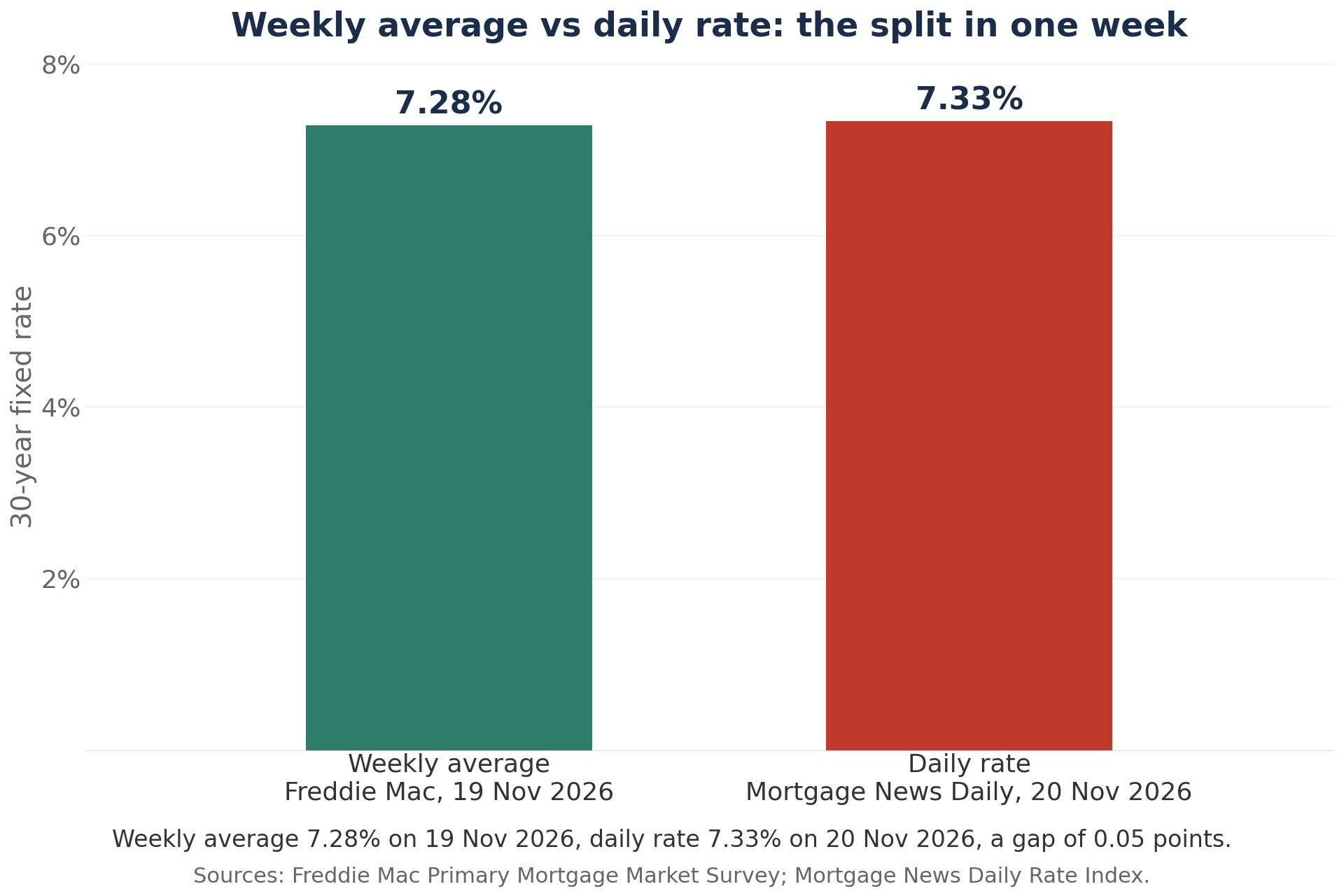
Mortgage rates weekly vs daily November 2026 flipped in a week. The Freddie Mac weekly average rose, ending four straight weeks of declines, then the daily rate fell the next day. The 30-year fixed-rate mortgage averaged 7.28% in the survey released Thursday 19 November 2026, up from 7.11%. One day later, the Mortgage News Daily daily index closed at 7.33% on Friday 20 November.
Both numbers are real: they measure different things on different schedules, and on Friday 20 November the daily rate stood 0.05 points above the weekly average.
The weekly number: 7.28%, the four-week fall is over
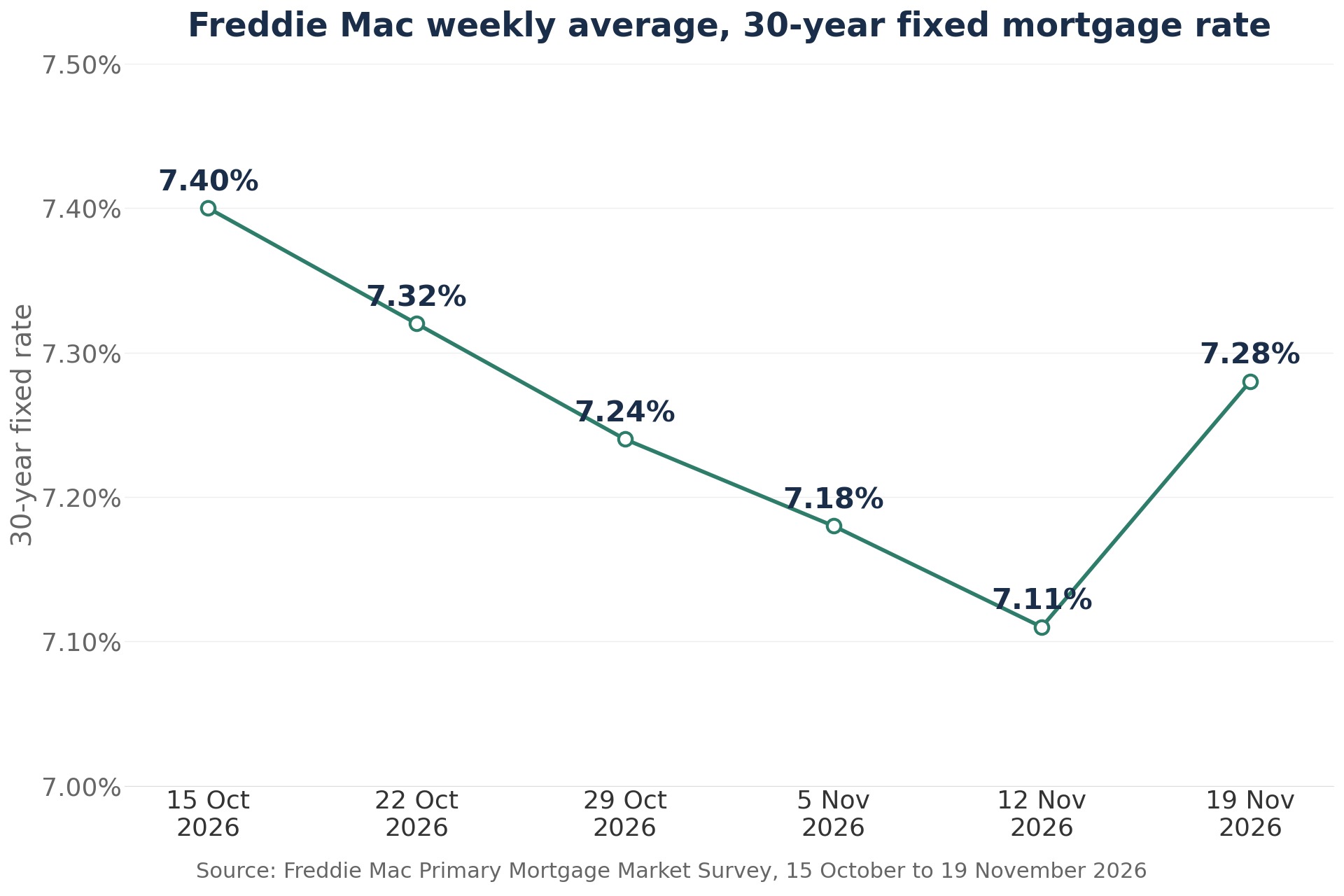
Freddie Mac's Primary Mortgage Market Survey, released Thursday 19 November 2026, put the 30-year fixed-rate mortgage at 7.28%, up 17 basis points from 7.11%. The 15-year fixed-rate mortgage averaged 6.66%, up 21 basis points from 6.45%.
It was the first weekly rise since the survey week ending 8 October 2026, when the average rose to 7.40%. A year ago at the same time, the 30-year averaged 6.26% and the 15-year averaged 5.54%, so the 30-year now stands 102 basis points higher than a year ago.
The rise is a matter of timing. The survey averages the five business days ending Wednesday, so the 19 November release covers Thursday 12 November through Wednesday 18 November. That window caught the post-CPI jump in full: the daily rate had hit 7.50% on Friday 13 November and 7.51% on Monday 16 November. The previous release, dated 12 November, had closed its window on Wednesday 11 November and missed the jump entirely.
When the average hit 7.11% a week earlier, Freddie Mac chief economist Sam Khater had said rates had dropped to their lowest level in seven weeks. In the 19 November release he turned to practical advice instead: "While prospective borrowers often shop around for a home, they may not always think to do the same for their mortgage, as comparing multiple rate quotes can potentially save them thousands over a loan's lifetime."
| Survey week | 30-year fixed | 15-year fixed |
|---|---|---|
| 8 October 2026 | 7.40% | 6.73% |
| 15 October 2026 | 7.40% | 6.71% |
| 22 October 2026 | 7.32% | 6.68% |
| 29 October 2026 | 7.24% | 6.60% |
| 5 November 2026 | 7.18% | 6.57% |
| 12 November 2026 | 7.11% | 6.45% |
| 19 November 2026 | 7.28% | 6.66% |
The 30-year average fell 29 basis points from its 7.40% peak on 8 and 15 October to 7.11% on 12 November, then rose 17 basis points to 7.28% on 19 November. The new reading is still 12 basis points below the October peak.
The daily number: 7.33% on Friday 20 November
The Mortgage News Daily (MND) index for a top-tier 30-year fixed loan closed at 7.33% on Friday 20 November 2026, down 0.12 percentage points on the day. MND wrote: "our rate index fell to 7.33% (down 0.12% from yesterday). This is the lowest level since November 10th."
The driver was the stock market, not housing data. MND wrote that rates had been improving through the week with help from weakness in the stock market, and that with multiple large tech stocks down more than 10%, Friday deserved consideration as the bad enough day to catch the bond market's attention. The 10-year Treasury yield fell more than 0.13% by 3 p.m. Eastern.
| Date | 30-year fixed | Change on the day |
|---|---|---|
| Mon 16 Nov 2026 | 7.51% | +0.01 |
| Tue 17 Nov 2026 | 7.48% | -0.03 |
| Wed 18 Nov 2026 | 7.46% | -0.02 |
| Thu 19 Nov 2026 | 7.45% | -0.01 |
| Fri 20 Nov 2026 | 7.33% | -0.12 |
Over the week to 20 November, the MND index fell 0.17 points, from 7.50% on 13 November to 7.33% on 20 November. The 15-year daily index closed at 6.89% on Friday 20 November, down 0.10 on the day and down from 7.03% on 13 November.
A week earlier the same index had moved the other way. It closed at 7.50% on Friday 13 November, after rising 0.32 points in three days on hot October CPI data. MND wrote: "In 3 short days, the average top tier 30yr fixed mortgage rate has risen 0.32% to 7.50%, erasing a vast majority of the improvement seen over the past 5 weeks." That jump is what the 19 November weekly average caught, and the week since has given back about half of it on the daily measure.
Why the two numbers point in opposite directions
The gap is a matter of method and timing. Different headlines quote different rates because they measure different things.
Freddie Mac's survey is a weekly average of applications. Since 17 November 2022, it has been built from mortgage applications submitted through Freddie Mac's Loan Product Advisor system, not from a survey of lenders.
Crucially, the survey averages the five business days ending Wednesday, so the 19 November release covers Thursday 12 November through Wednesday 18 November. The jump to 7.50% on 13 November and 7.51% on 16 November fell inside that window, which is why the weekly average rose. But Friday's fall to 7.33% came after the window closed, so it is not in the 7.28% figure.
The MND index is a daily snapshot of lender rate sheets, published on weekdays around 4 p.m. Eastern, from actual lender rate sheets. It uses a top-tier baseline, 75 loan-to-value and 780 FICO.
Because the MND index reacts the same day the bond market moves, it captured Friday's fall in full. The weekly average will not reflect it until the next release.
The trigger: hot October CPI on Tuesday 10 November
The turn began with inflation data. The Bureau of Labor Statistics released the October 2026 Consumer Price Index on Tuesday 10 November 2026. Headline CPI increased 0.4% on a seasonally adjusted basis in October, after rising 0.6% in September. Core CPI rose 0.3% in October, as it did in September and August.
No 12-month change was published for October 2026. The BLS did not collect survey data for October 2025 because of a lapse in appropriations, so no 12-month change could be published.
On 10 November, MND wrote that the CPI report came in hotter than expected and that the average top-tier 30-year fixed rate ended the day 0.12% higher at 7.30%, the first serious break in a calm run. See our full October CPI report.
Demand rose before the jump
The weekly surveys captured a real rebound in demand before rates turned. Mortgage applications rebounded in the week ending 6 November 2026: total applications increased 6.2% from one week earlier on a seasonally adjusted basis, according to the Mortgage Bankers Association.
The seasonally adjusted Purchase Index increased 8% from one week earlier, but was 18% lower than the same week one year ago. The Refinance Index increased 5% and was 57% lower than a year ago.
The MBA's own rate measure also fell: the average contract rate for 30-year fixed-rate mortgages with conforming loan balances ($832,750 or less) decreased to 7.21% from 7.30%. MBA Vice President and Deputy Chief Economist Joel Kan said: "Mortgage rates declined for the fourth straight week, with the 30-year fixed rate dropping to 7.21 percent, the lowest rate since mid-September."
What the split means if you are deciding whether to lock or wait
The two numbers answer different questions. The Freddie Mac weekly average is the better guide to the trend: rates rose 17 basis points this week after falling 29 basis points from their October peak. The MND daily index is the better guide to what a lender is likely to quote you today: as of Friday 20 November, that was 7.33% for a top-tier borrower, not 7.28%.
Either headline alone misleads: the weekly average had not yet seen Friday's fall, and the daily rate had not yet shown whether the fall would hold.
A rate lock fixes the rate on offer at the time you lock, not the weekly average. If your lender quotes 7.33%, the 7.28% weekly average does not change that quote. Khater's advice in the latest release was practical: comparing multiple rate quotes can potentially save thousands over a loan's lifetime.
The next Freddie Mac release is expected on Wednesday 25 November 2026, a day early because Thanksgiving falls on Thursday 26 November.
For buyers, the lesson is simpler: check whether a quoted rate is a weekly average or a daily rate, and read its date. Sellers face the same squeeze: US home sale prices fell for the first time in over three years.
Frequently Asked Questions
What was the average 30-year mortgage rate in the Freddie Mac survey released 19 November 2026?
Freddie Mac's weekly average for the 30-year fixed-rate mortgage was 7.28% on 19 November 2026, up from 7.11%. The 15-year averaged 6.66%, up from 6.45%, in the first weekly rise after four straight declines.
Why did the daily mortgage rate fall to 7.33% on Friday 20 November?
The Mortgage News Daily daily index closed at 7.33% on Friday 20 November 2026, down 0.12 points on the day. Mortgage News Daily called it the lowest level since 10 November. Weakness in the stock market, with multiple large tech stocks down more than 10%, pulled bond yields lower, and the 10-year Treasury yield fell more than 0.13% by 3 p.m. Eastern.
Why do the Freddie Mac weekly rate and the daily rate disagree?
Freddie Mac averages the five business days ending Wednesday, so the 19 November release covers 12 to 18 November and includes the jump to 7.50% on 13 November, but not Friday's fall to 7.33%. Mortgage News Daily publishes a daily snapshot from actual lender rate sheets, so it captured Friday's fall the same day.
What did the October CPI report show?
The Bureau of Labor Statistics released the October 2026 CPI on Tuesday 10 November 2026. Headline CPI rose 0.4% in October, and core CPI rose 0.3%. No 12-month change was published.
Did mortgage applications rise as rates fell?
Yes, before the daily rate jumped. Total mortgage applications increased 6.2% from one week earlier in the week ending 6 November 2026. The Purchase Index rose 8% and the Refinance Index rose 5%.
When is the next Freddie Mac mortgage rate release?
The next Freddie Mac release is expected on Wednesday 25 November 2026, a day early because Thanksgiving falls on Thursday 26 November.
Sources: Freddie Mac, Primary Mortgage Market Survey release, 19 November 2026, and PMMS archive; Mortgage News Daily, MND Rate Index and daily articles, 10, 12, 13, 19 and 20 November 2026; U.S. Bureau of Labor Statistics, Consumer Price Index, October 2026 (USDL-26-1685), 10 November 2026; Mortgage Bankers Association, "Mortgage Applications Increase in Latest MBA Weekly Survey", 11 November 2026. Checked 2026-11-21.