Mortgage Demand Jumped, but Golden Handcuffs Hold Sellers

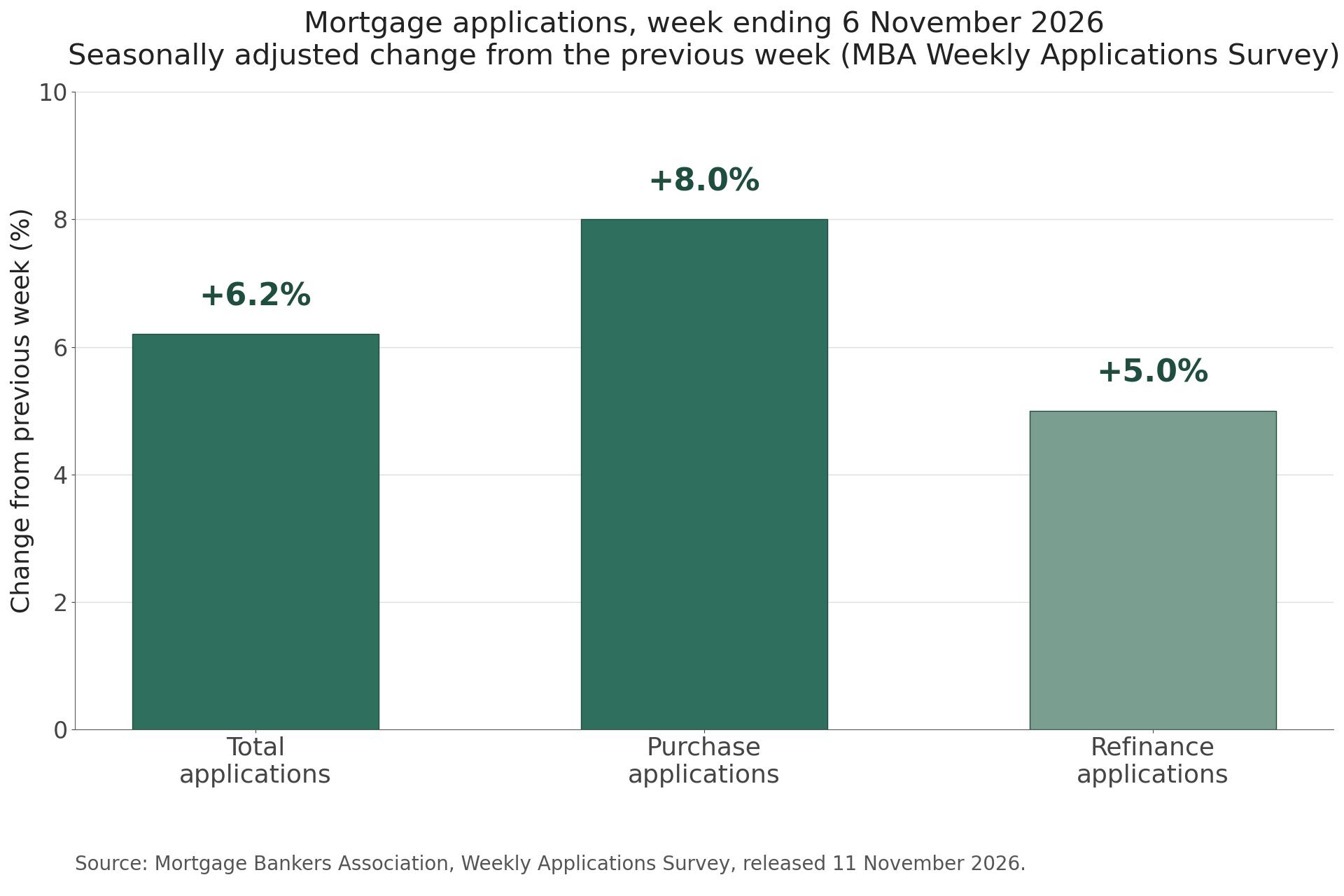
mortgage demand golden handcuffs November 2026 captures a split market: total applications rose 6.2 percent from one week earlier in the week ending 6 November 2026, because rates fell for a fourth straight week, according to the Mortgage Bankers Association, and purchase applications rose 8 percent on a seasonally adjusted basis. Bloomberg called it the biggest jump in home purchase applications since mid-April.
Yet existing-home sales fell to their lowest since August 2010 in October. The two facts fit once you see the lock-in effect: most outstanding mortgages carry rates so low that their holders cannot afford to give them up, so the homes they would have sold never reach the market. For a buyer who can act now, that split is a real opening, but no promise rates will keep falling.
The demand jump
The Mortgage Bankers Association release of 11 November 2026 tells the story. Total applications increased 6.2 percent from one week earlier on a seasonally adjusted basis. The Purchase Index rose 8 percent, and the Refinance Index 5 percent, but both are still far below last year: purchases 18 percent lower, refinances 57 percent lower. See our earlier mortgage applications rebound report.
Rates did the work. The average contract rate for a 30-year fixed mortgage with a conforming loan balance of 832,750 dollars or less fell to 7.21 percent from 7.30 percent. The MBA called it the fourth straight weekly decline and the lowest rate since mid-September.
Joel Kan, MBA Vice President and Deputy Chief Economist, said: "Mortgage rates declined for the fourth straight week, with the 30-year fixed rate dropping to 7.21 percent, the lowest rate since mid-September. Moreover, the FHA rate was back below 7% and was more than 20 basis points lower than the conforming rate, which helped first-time home buyers currently in the market."
Freddie Mac confirmed the direction a day later. The 30-year fixed-rate mortgage averaged 7.11 percent as of 12 November 2026, down from 7.18 percent the week before and up from 6.24 percent a year earlier. The 15-year averaged 6.45 percent, down from 6.57 percent. It was the fourth consecutive weekly decline, which Freddie Mac chief economist Sam Khater called the lowest level in seven weeks.
The lock-in
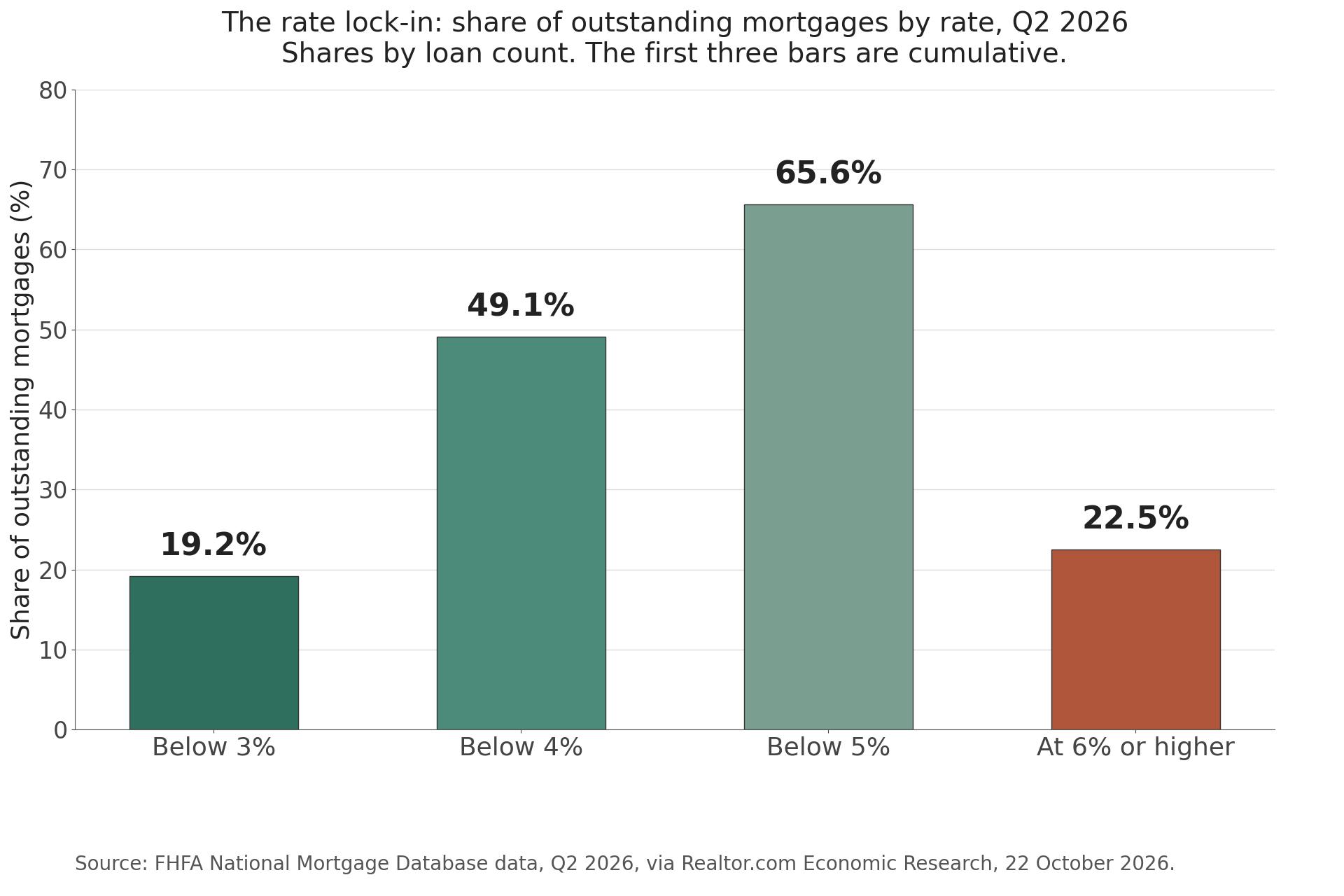
In the second quarter of 2026, 19.2 percent of outstanding mortgages had an interest rate below 3 percent, and 49.1 percent had a rate below 4 percent, per Realtor.com Economic Research analysis of FHFA National Mortgage Database data. A further 16.5 percent sat between 4 and 5 percent, so 65.6 percent were below 5 percent, and 22.5 percent carried a rate of 6 percent or higher.
Those are shares of outstanding mortgages, not of homeowners: owners who own outright are not in this denominator.
FHFA Staff Working Paper 24-03 found that for every percentage point that market mortgage rates exceed the origination interest rate, the probability of sale is decreased by 18.1 percent. Lock-in led to a 57 percent reduction in home sales with fixed-rate mortgages in the fourth quarter of 2023 and prevented 1.33 million sales between the second quarter of 2022 and the fourth quarter of 2023.
The paper also found the supply reduction lifted home prices by 5.7 percent, outweighing the direct impact of elevated rates, which cut prices by 3.3 percent.
Sales still fell to their lowest since August 2010
The National Association of Realtors reported that existing-home sales fell 5.5 percent month over month and 8.8 percent year over year in October 2026, to a seasonally adjusted annual rate of 3.75 million, the lowest level since August 2010. See our existing-home sales report.
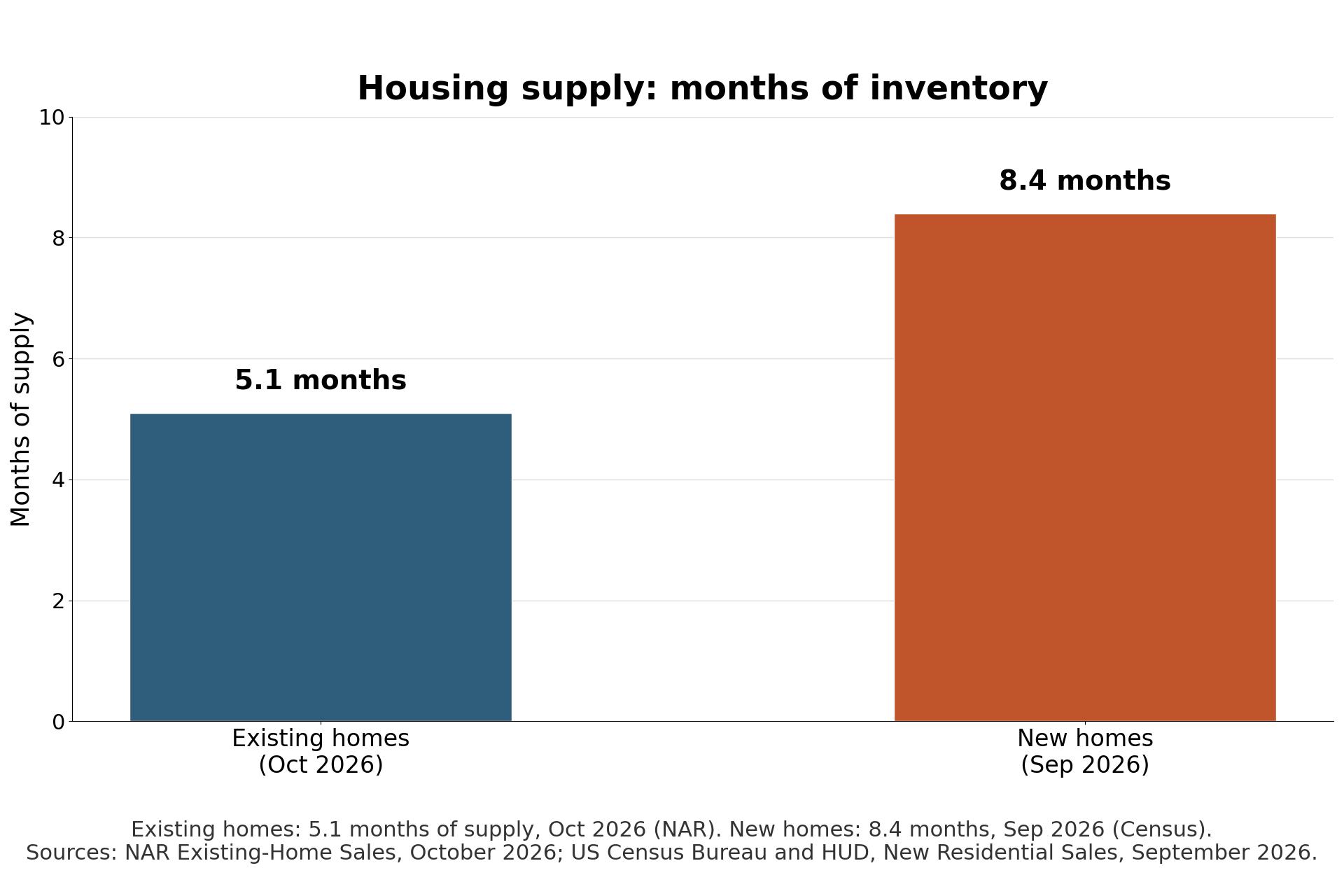
Prices did not follow sales down. The median existing-home price was 416,700 dollars, up 0.4 percent from 414,900 dollars one year earlier, the 40th consecutive month of year-over-year price increases. Total housing inventory was 1.59 million units at the end of October, a 5.1-month supply, up from 4.7 months. The median time on market was 35 days, up from 33 days.
New homes tell a similar story. Sales of new single-family houses in September 2026 were at a seasonally adjusted annual rate of 676,000, down 0.6 percent from August and 5.3 percent from September 2025, according to the US Census Bureau and HUD, though both changes carry an asterisk in the release, meaning the change is not statistically significant. New houses for sale totalled 476,000, or 8.4 months of supply. The median price was 400,400 dollars. See our new-home sales report.
Why this is a buyer leverage moment
Demand is rising because rates fell, but the buyer pool is still well below last year: purchases 18 percent lower than a year ago, refinances 57 percent lower. A buyer who is ready now faces fewer rival buyers than in a normal market. The seller surplus is the widest since 2013, the same squeeze from the seller's side.
That is the moment to negotiate. A seller who has waited five weeks may be more open to a concession than one who listed yesterday. Consider asking for seller-paid closing cost help, a rate buydown, or a 2-1 buydown for the first two years, and get any concession written into the contract.
First-time buyers have a tailwind: the FHA rate is back below 7 percent, at 6.98 percent. Weigh that against the down-payment assistance tradeoff first. Push hardest on homes that have sat, and on new builds, where builders hold 8.4 months of supply and often prefer incentives to price cuts.
The warning: do not bet on rates falling further
None of this is a reason to buy a home you cannot afford at today's rate. The 30-year fixed rate is 7.11 percent in the Freddie Mac survey, still up from 6.24 percent a year earlier, and the October average was 7.33 percent. Rates have fallen for four weeks, but that is a short run, and the daily market can turn quickly. Check whether a quoted rate is a weekly average or a daily quote in our explainer on why mortgage rate headlines disagree.
A 2-1 buydown is useful only if the home works at the full rate after the buydown ends. Buy on the numbers you can lock today, and treat any further fall as a bonus to refinance into later, not part of the plan. Lock-in cuts the other way for sellers: moving means giving up a rate below 5 percent, which 65.6 percent of outstanding mortgages carry, for a loan near 7 percent.
Frequently Asked Questions
How much did mortgage applications rise?
Total applications rose 6.2 percent from one week earlier, seasonally adjusted, in the week ending 6 November 2026, per the MBA. The Purchase Index rose 8 percent and the Refinance Index 5 percent, though purchases were still 18 percent lower than last year.
What was the 30-year mortgage rate?
Freddie Mac put the 30-year fixed rate at 7.11 percent as of 12 November 2026, down from 7.18 percent. The MBA's measure for the week ending 6 November was 7.21 percent, down from 7.30 percent.
What is the lock-in effect?
Borrowers resist selling when their rate is far below today's rates, because selling means giving up the cheap rate and borrowing again near 7 percent. In the second quarter of 2026, 65.6 percent of outstanding mortgages were below 5 percent.
Why are sales at their lowest since 2010?
Existing-home sales fell to a seasonally adjusted annual rate of 3.75 million in October 2026, the lowest since August 2010, and a major factor is that locked-in sellers are not listing. The median price still rose to 416,700 dollars.
How much housing supply is there now?
Existing-home inventory was a 5.1-month supply at the end of October 2026. New homes for sale were 8.4 months of supply at the end of September, with 476,000 new houses for sale.
Should buyers wait for rates to fall further?
No, not as a plan. Rates have fallen for four straight weeks to 7.11 percent, but they are still up from 6.24 percent a year earlier. Buy only if the home works at the rate you can lock today.
Sources: Mortgage Bankers Association, MBA Weekly Survey, 11 November 2026; Freddie Mac, Primary Mortgage Market Survey, 12 November 2026; National Association of Realtors, Existing-Home Sales, October 2026, 12 November 2026; US Census Bureau and HUD, New Residential Sales, September 2026 (CB26-174), 27 October 2026; Realtor.com Economic Research, FHFA National Mortgage Database analysis, Q2 2026; FHFA Staff Working Paper 24-03, March 2024; Bloomberg via The Edge Malaysia, 11 November 2026. Checked 2026-11-18.