NAHB Homebuilder Sentiment Fell to 25 in November 2026
NAHB homebuilder sentiment November 2026 fell to 25, the lowest reading since April 2012. The NAHB/Wells Fargo Housing Market Index dropped four points from 29 in October, after 32 in September. A reading of 25 sits far below the 50 mark that separates a market builders see as good from one they see as poor.
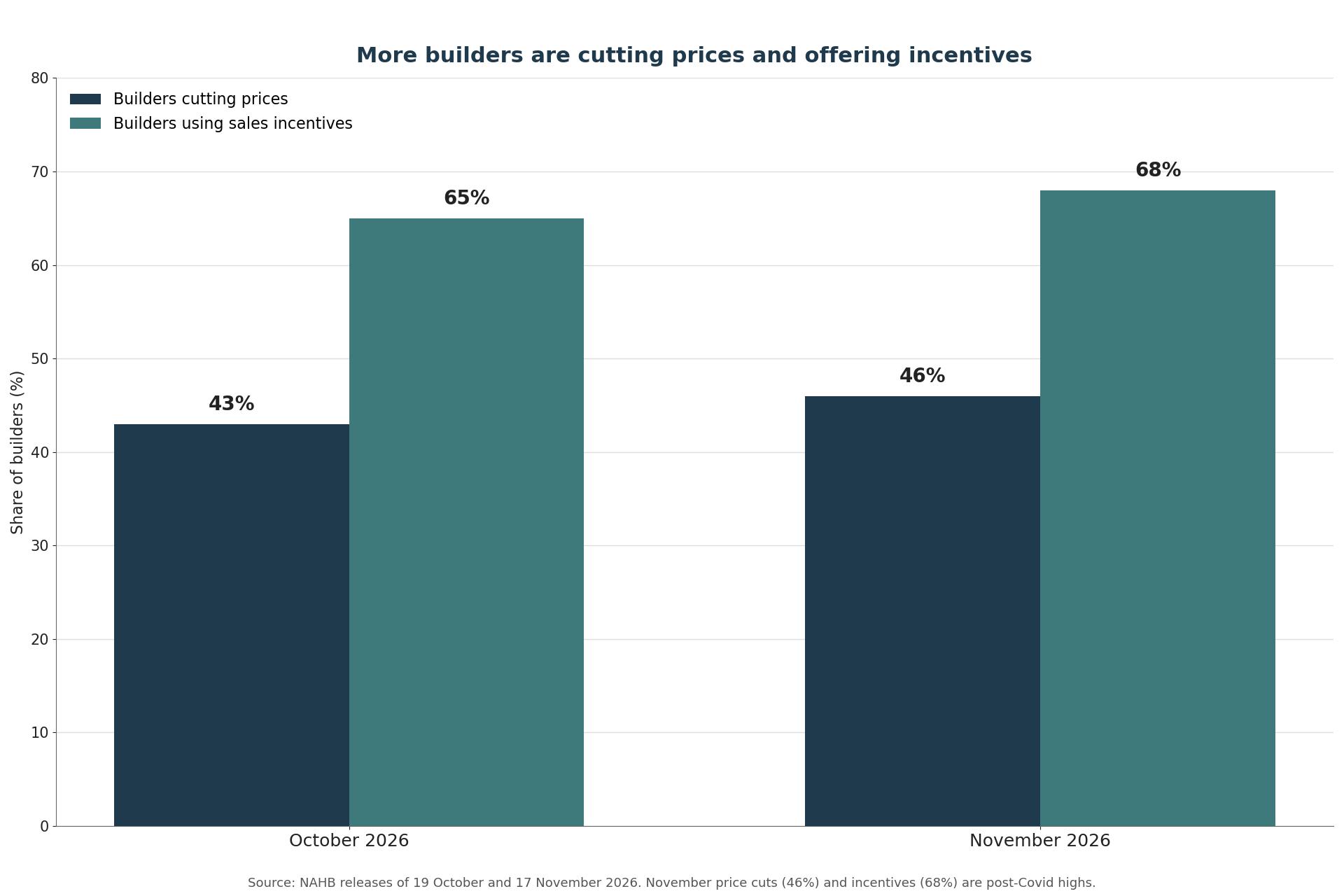
For buyers, what matters is what builders are doing about it. In November, 46% of builders cut prices, the highest share in the post-Covid period, and 68% offered sales incentives, also a post-Covid high. The average price cut held at 6% for an eighth straight month.
That makes new builds the more negotiable option right now. Here is what the November reading means, why it fell, and how to use it if you are shopping for a new home.
What a reading of 25 actually means
The Housing Market Index runs on a scale of 0 to 100, and any number over 50 means more builders view conditions as good than poor. It comes from a monthly survey the National Association of Home Builders has run for more than 40 years, measuring builder perceptions of sales, expected sales, and buyer traffic, not prices or volumes. Read it as a mood gauge, not a price index.
At 25, the gauge is deep in pessimistic territory:
| Component | November 2026 | Change from October |
|---|---|---|
| Current sales conditions | 28 | Down 6 points |
| Sales expectations, next six months | 30 | Down 2 points |
| Prospective buyer traffic | 16 | Down 2 points |
Buyer traffic is the weakest part: the index fell two points to 16, its lowest level in 15 years, excluding the start of the pandemic in 2020. Very few buyers are walking through model homes.
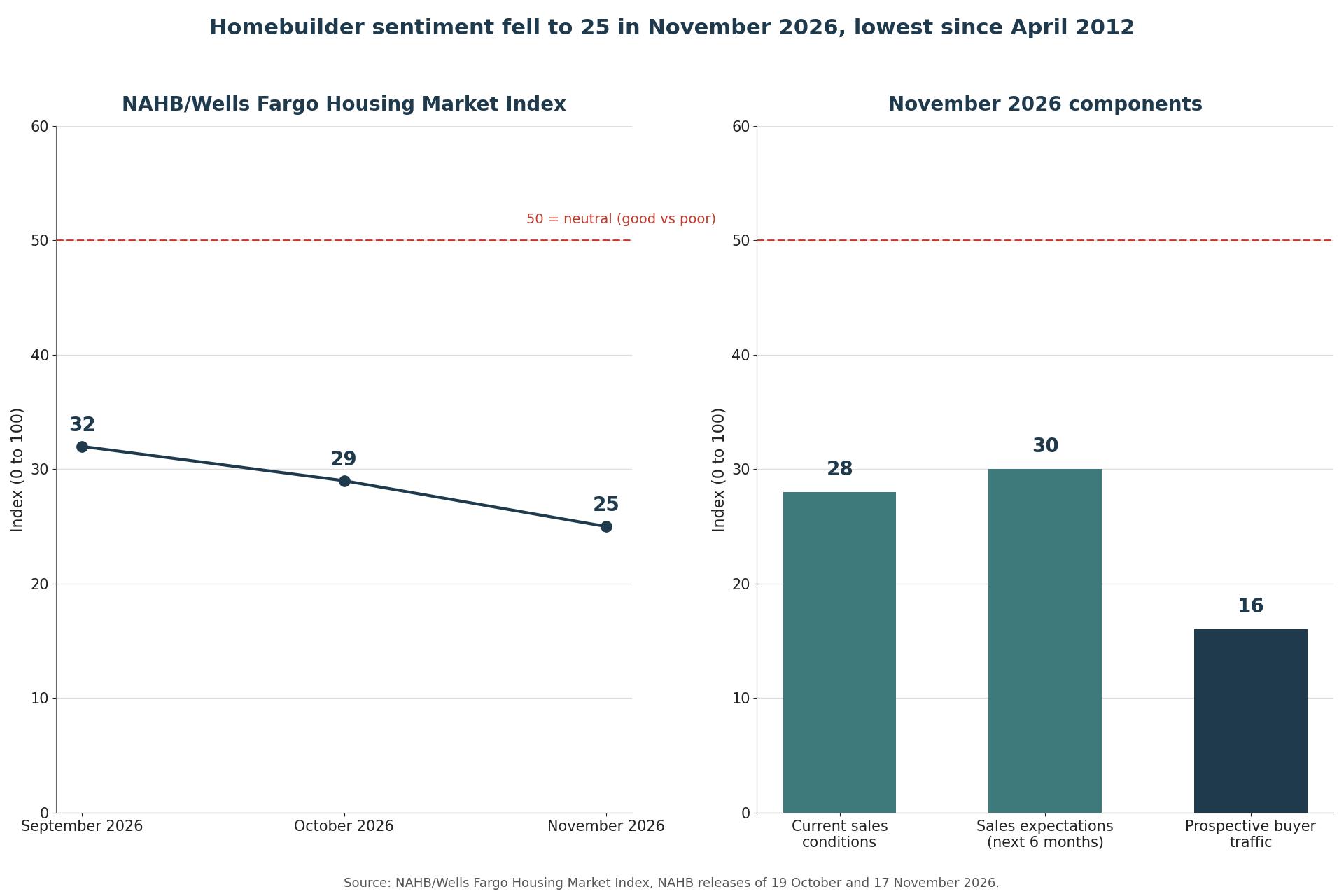
October's 29 was already the lowest since June 2012, as we covered in our October homebuilder sentiment report. November went four points lower, to the lowest since April 2012, about 14 years and 7 months ago.
Why sentiment fell
The November release points to five pressures: high mortgage rates, ongoing inflation pressure, elevated energy and material costs, rising labor shortages, and hesitant buyers.
NAHB Chief Economist Robert Dietz put the supply side first: "The housing market faces a range of supply-side challenges, including building material costs pushed higher by tariffs, an ongoing shortage of construction workers and excessive regulations that undermine housing affordability. Mortgage rates above 7%, softer consumer confidence and an uncertain economic outlook are holding buyers back."
NAHB Chairman Bill Owens, a home builder and remodeler from Worthington, Ohio, said: "Builders are confronting multiple challenges in today's economy. Stepped-up immigration enforcement is keeping legal workers off job sites, deepening labor shortages and driving up costs. Higher fuel prices are prompting subcontractors to raise their rates sharply, and with fewer buyers in the market, more builders are scaling back construction."
Costs are rising while buyers pull back, and with mortgage rates above 7%, the monthly payment stays out of reach for many households. Inflation adds to the strain: October CPI rose 0.4%.
Price cuts and incentives: the discount is now the norm
In November, 46% of builders reduced prices, the highest share in the post-Covid period, and the average cut held at 6% for an eighth straight month.
Incentives are even more widespread: 68% of builders used them in November, also a post-Covid high, in the 20th consecutive month in which at least 60% did so.
October was already weak, and November was weaker on both counts:
| October 2026 | November 2026 | |
|---|---|---|
| Builders cutting prices | 43% | 46% |
| Average price cut | 6% | 6% |
| Builders using incentives | 65% | 68% |
October already set records of its own: 43% cut prices, the highest share during the 2020-2026 period, and 65% used incentives, the 19th straight month at least 60% did so. November beat both marks.
Why new builds are the more negotiable buy
A builder with slow traffic and rising costs has a reason to deal, and the November numbers show dealing is now the norm: nearly half of builders are cutting prices and more than two in three are offering incentives.
An existing-home seller faces a different calculation: a homeowner selling one house can wait, take it off the market, or hold firm on price. A builder with finished homes and carrying costs cannot wait as easily, and the November release says more builders are scaling back construction rather than building into a weak market.
That does not mean every new build is a bargain: a 6% average cut is an average, not a promise, measured against a list price that may already include room to move. But the direction is clear: between a new build and an existing home, the new build is the one where the seller is openly discounting.
The regional picture: every region fell
Sentiment fell in every region in November, on three-month moving averages, and every region sits below 50, so the gloom is national, not local.
| Region | November 2026 | Change |
|---|---|---|
| Northeast | 34 | Down 4 points |
| Midwest | 35 | Down 5 points |
| South | 27 | Down 3 points |
| West | 23 | Down 3 points |
What to do if you are buying a new build now
Start by asking directly what the builder is offering. The discount is often already on the table, but its size varies by builder and community, so get any cut and incentive in writing before you sign, and ask what it is worth in real money, not just as a headline.
Do not skip the inspection: a new build is still a house, and defects happen even in fresh construction. Our new-build defects checklist covers what to look for before you close, and an independent inspection is worth the cost on a purchase this large.
Finally, keep the rate in view. A price cut helps, but the monthly payment is set mostly by the mortgage rate, and rates are above 7%. Run the payment at the rate you can actually lock, not the rate you hope for.
Sentiment has fallen for two months running, from 32 in September to 29 in October to 25 in November. Until the next monthly release shows whether the slide continues or finds a floor, buyers have something they have not had in a long time: a new-build market where the seller is the one making concessions.
Frequently Asked Questions
What is the NAHB homebuilder sentiment reading for November 2026?
The NAHB/Wells Fargo Housing Market Index fell four points to 25 in November 2026, down from 29 in October and 32 in September. It is the lowest reading since April 2012.
What does an HMI reading of 25 mean?
The index runs 0 to 100, and any number over 50 means more builders view conditions as good than poor, so 25 means most view them as poor. It measures builder perceptions of sales, expected sales, and buyer traffic, not prices or volumes.
How many builders are cutting prices on new homes?
In November 2026, 46% of builders reduced prices, the highest share in the post-Covid period. The average price reduction held at 6% for an eighth straight month.
What incentives are builders offering?
In November 2026, 68% of builders used sales incentives, also a post-Covid high, in the 20th consecutive month in which at least 60% did so.
Why is builder sentiment falling?
NAHB cites high mortgage rates, ongoing inflation pressure, elevated energy and material costs, rising labor shortages, and hesitant buyers. Chief Economist Robert Dietz added tariffs pushing material costs higher, a worker shortage, excessive regulations, mortgage rates above 7%, softer consumer confidence, and an uncertain economic outlook.
Is now a good time to buy a new build?
The numbers point to a buyer's opening on price, but mortgage rates above 7% remain the bigger constraint on the monthly payment, so run the numbers at the rate you can actually lock before deciding.
Sources: National Association of Home Builders, "Builder Sentiment Continues to Fall on Affordability Concerns", 17 November 2026; National Association of Home Builders, "Builder Sentiment Falls on Rising Rates", 19 October 2026; NAHB Housing Market Index page. Checked 2026-11-18.