Spice Cabinet Organization Ideas You'll Wish You Tried Sooner
There is a special frustration in digging through a dark cabinet, sniffing jar after jar, while dinner burns. If your spice collection is a jumbled avalanche of mismatched jars, these spice cabinet organization ideas are for you: the great spice purge, the best storage methods for your space and budget, labeling systems that stick, the decanting debate, small-kitchen workarounds, and a simple maintenance routine so it stays tidy long after the organizing high wears off.
Start With the Great Spice Purge
Before you buy a single organizer, get honest about what you own. Pull every spice out of the cabinet and set it on the counter. You cannot organize clutter — you can only organize what remains after the clutter leaves.
Ground vs. Whole Spices
Ground spices lose their punch fast — most are at their best within 6 to 12 months of opening. Whole spices (cinnamon sticks, peppercorns, cumin seed) keep longer, often a year or more, because their flavor stays locked inside until you grind them.
Use this as your rough sorting rule: ground spices opened more than a year ago are prime purge candidates; whole spices over a couple of years old deserve a test; and anything you can't remember buying goes to the sniff test.
The Sniff Test
Open the jar and smell it. Strong, vivid aroma? Keep it. Faint or "meh"? It's on borrowed time — if it's something you use weekly, replace it soon; if it's the cardamom from one recipe in 2023, let it go. No smell at all, or smells like dust? Toss it. A spice with no flavor isn't seasoning your food — it's just taking up real estate.
Duplicates and One-Recipe Wonders
Combine duplicates — that half-used paprika plus the nearly-full paprika becomes one jar. And be real about the one-recipe wonders: the sumac for that grain bowl, the juniper berries from a cocktail phase. If you haven't reached for it in a year, release it. (Donate unopened, in-date jars to a neighbor or food bank.)
Storage Methods Compared: Pick What Fits Your Kitchen
There is no single "best" way to store spices. The best system fits your cabinet size, your budget, and the way you cook.
Drawer Inserts
If you have a spare drawer near the stove, this is the gold standard. Jars lie flat in a sloped insert so every label faces up — no digging, no stacking, no knocked-over jars. Bamboo inserts are inexpensive, and a shallow dollar-store cutlery tray does the same job on a smaller scale. Best for cooks who grab spices constantly and want everything visible at a glance.
Tiered Risers (Stepped Shelves)
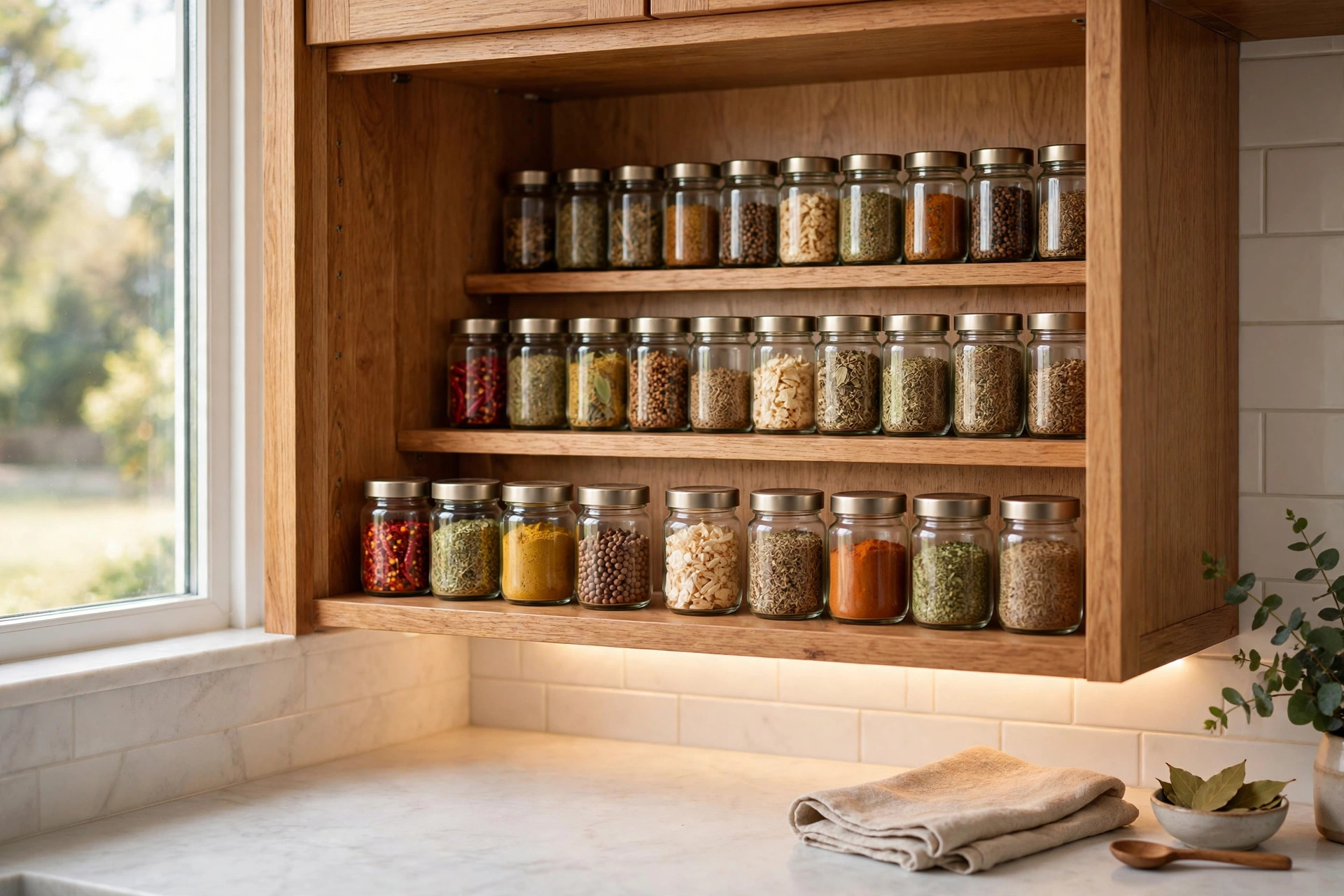
These little staircases lift the back rows of a cabinet so you can actually see them — the cheapest fix for the deep-cabinet problem where you own three cinnamons because you couldn't see the first two. Best for standard upper cabinets. Budget tip: small bamboo risers are cheap, or DIY one from scrap wood or stacked boxes covered in contact paper.
Door Racks
The inside of a cabinet door is wasted vertical space begging for slim spice racks. Wire or plastic racks mount with adhesive strips or small screws and keep jars upright and visible. Great for renters (adhesive versions need no drilling) and kitchens short on shelf space. Just check door clearance first — the rack must still let the door close fully.
Magnetic Wall Spice Tins
Small metal tins with clear lids stick to a magnetic strip or fridge side, turning your everyday spices into visible, grab-and-go decor. Perfect for small kitchens with zero cabinet space. One warning: heat and sunlight kill flavor fast, so don't mount them next to the stove or on a sun-baked wall.
Turntables (Lazy Susans)
A spinning tray means nothing hides in the back of the cabinet. A double-decker turntable uses vertical space too, and a basic plastic one costs just a few dollars.
Labeling Systems That Actually Work
Organization falls apart the moment you can't tell the paprika from the cayenne. (Learned the hard way, so you don't have to.)
- Label the lids, not just the sides. If jars stand upright, the lid is what you see. In a drawer, the lid is all you see.
- Keep labels uniform. Pick one style — handwritten chalk labels, printed labels, or round sticker dots — and commit. Consistency makes the collection easier to scan.
- Include the date. Write the month and year you bought or opened the spice on the bottom of the jar. Future-you, mid-purge, will be grateful.
- Alphabetize. A-to-Z is the only system that survives real life. Mid-recipe with flour on your hands, alphabetical beats any category scheme you'll abandon in a month.
The Decanting Debate: Pros and Cons
Transferring spices into matching jars looks gorgeous. But is it worth it?
Pros: Uniform jars stack neatly and fit organizers better than random brand shapes. You can buy cheaper bulk refills. Clear, matching jars make labels and levels easy to read.
Cons: It's a project — doing it for 40+ spices in one sitting means burnout and a turmeric-dusted countertop. You lose the original "best by" date and brand info (another reason to date the jar's bottom). And if your pretty jars don't seal well, you're trading looks for stale spices.
The middle ground: Decant only your 10 to 15 everyday staples into matching jars and leave the specialty ones in their original containers. You get most of the visual calm with a fraction of the effort.
Small-Kitchen Solutions
No pantry, no spare drawer, no problem. Small kitchens just need to think vertically.
- Use the cabinet door for slim adhesive racks — it's free square footage.
- Go magnetic on a fridge side, a metal backsplash panel, or a magnetic board mounted inside a pantry door.
- Stack up, not out: a slim two-tier riser fits a cabinet barely wider than a dinner plate.
- Keep a "daily driver" kit. Your 6 to 8 most-used spices live in a small caddy on the counter; everything else can live somewhere slightly less convenient. You don't need the whole collection at arm's length — just the greatest hits.
- Store overflow elsewhere. Bulk refills and rarely-used spices can live in a labeled bin on a high shelf or in a closet. Your working collection should be lean.
Keeping It Maintained: The 10-Minute Spice Routine
An organized spice cabinet stays organized with tiny habits, not heroic reorganization weekends.
- One in, one out. When a new jar of cumin arrives, finish or toss the old one. Don't let two half-jars coexist.
- Date every newcomer. The second a new spice enters the house, write the purchase month on the bottom. Five seconds.
- Sniff sweep twice a year. Pick an easy anchor — when the clocks change, or the first weekend of spring and fall. Pull jars out, sniff the dusty ones, toss the dead ones. Ten minutes, done.
- Resist the souvenir spice. That exotic blend from the farmers market is lovely, but without a recipe in mind for it, it's tomorrow's clutter.
Frequently Asked Questions
How often should I replace ground spices?
As a general rule, ground spices are at their best for about 6 to 12 months after opening, and whole spices can last a year or more. But dates are just a starting point — the sniff test is the real answer. Strong smell, keep it; no smell, replace it.
Is it okay to store spices above the stove?
It's convenient, but not ideal. Heat and steam dull flavor fast. If that cabinet is your only option, keep jars sealed and toward the front, away from the heat source. A nearby drawer is a better home if you have one.
Should I decant spices into matching jars?
It depends on your priorities. Decanting looks great and makes storage uniform, but it takes time and you lose the original packaging info. A good compromise is decanting only your most-used spices and leaving the rest as-is. Whatever you choose, use airtight jars and label everything.
What's the cheapest way to organize a spice cabinet?
Start free: purge the expired spices, combine duplicates, and arrange what remains alphabetically. Then add one budget tool — a turntable or tiered riser costs just a few dollars and solves the biggest visibility problems. Label lids with a marker and round stickers from the dollar store.
How do I organize spices in a really small kitchen?
Go vertical: cabinet-door racks, magnetic tins on a fridge side or metal panel, and a slim tiered riser inside the cabinet. Keep only your 6 to 8 daily-use spices in a countertop caddy, and store bulk refills and specialty spices in a labeled bin on a high shelf or in another room.